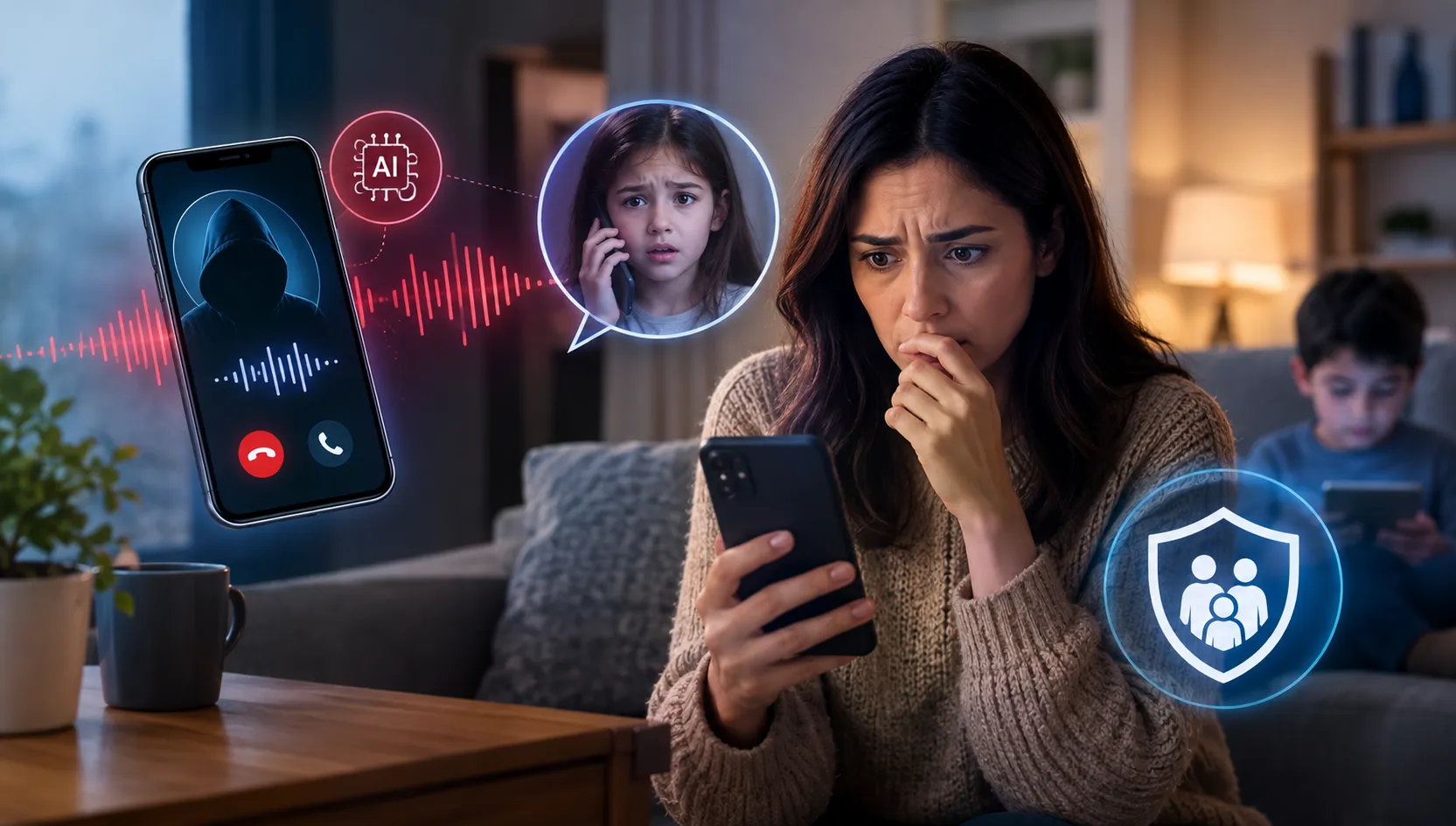
Your phone rings on a quiet Tuesday afternoon. You answer, and your 14-year-old daughter is screaming into the speaker: "Mom, help me! Please! These men took me, they put me in a truck—Mom, please!"
Before you can catch your breath, a harsh man's voice cuts in: "Listen carefully. We have your daughter. If you hang up or call the police, she won't see tomorrow. Wire $10,000 via Venmo right now, or you'll never see her again."
Your heart stops. The crying, the panting breaths, the familiar stammer—it sounds 100% identical to your child. But your daughter is sitting safely in fifth-period biology class, completely unaware of the nightmare unfolding in your living room.
This is not science fiction. In 2026, AI-generated voice scams are becoming an increasingly important tool in impersonation and emergency scams targeting families. According to cybersecurity advisories from the Federal Trade Commission (FTC) and the Federal Bureau of Investigation (FBI), criminals no longer need high-end studio gear—modern AI tools can generate convincing voice imitations from relatively short audio samples shared online. The FBI's 2025 IC3 report recorded 22,364 complaints involving AI and more than $893 million in adjusted losses. The report also specifically identified AI voice cloning in "distress" scams, in which victims reported more than $5 million in losses.
Key Takeaway for Every Parent
In 2026, hearing your child's voice on the phone is no longer definitive proof of identity. Scammers can use generative AI audio tools and caller ID spoofing to stage convincing fake emergencies. Your family's most reliable defense is to slow down, disconnect, and verify independently, supported by a private Family Safe Word. Never wire money, transfer cryptocurrency, or purchase gift cards during an urgent or coercive phone call.
In this guide, we explain how voice-cloning technology works, examine why these high-pressure calls are so effective, reveal where scammers gather family information, and provide practical verification steps to protect your household.
How an AI Voice and Virtual Kidnapping Scam Works
AI voice cloning can make a virtual kidnapping scam sound much more convincing. The criminal doesn't necessarily need access to the victim—they may use publicly available audio, personal information, caller-ID spoofing, and psychological pressure to create the appearance of an emergency.
Just a few years ago, creating a convincing voice clone required hours of clean, studio-quality speech recorded in an echo-free booth. Today, neural acoustic models have advanced to what engineers call "few-shot voice synthesis."
Here is the four-step pipeline criminals use to execute this fraud:
- Audio Harvesting: The perpetrator finds a public video featuring your child speaking—a TikTok clip, an Instagram Reel, a school sports interview, or a YouTube video.
- Model Ingestion: The scammer extracts the audio track and feeds it into commercial or open-source generative voice software. Modern synthesis tools analyze the child's vocal pitch, timbre, accent, and speech cadence to construct a synthetic voice profile.
- Prompt Engineering with Emotional Inflection: The scammer inputs a distress script into the model: "Mom, I was in a car crash, please help me!" Modern generative audio models can synthesize distress tremors, sobbing inflection, and ambient background road noise.
- Caller ID Spoofing & High-Pressure Call: Using internet VoIP spoofing tools, the criminal places a call that displays on your screen as "Unknown," a local area code, or even your child's actual phone number. They play the distress audio, create intense panic and urgency, and demand immediate payment through methods that can be difficult to reverse or recover, such as cryptocurrency, wire transfers, payment apps, or gift cards.
How Much Audio Does Voice Cloning Actually Need?
Voice-cloning technology can create convincing imitations from relatively short audio samples. The amount of audio needed varies by technology, recording quality, background noise, and the specific model used, so there is no single reliable "3-second rule." However, because even brief public video clips can provide enough acoustic data for modern synthesis tools, any publicly accessible audio poses potential privacy and impersonation risks.
The Anatomy of the Trap: Why Even Smart Parents Fall For It
Many parents read about virtual kidnapping scams and think, "I would never fall for that. I know my kid's voice, and I'm too smart to wire money to a stranger."
A convincing emergency call can trigger a strong stress response, making it harder to slow down and evaluate what you are hearing. That is exactly why scammers use urgency, threats, and emotional manipulation: to pressure victims into acting before they have time to verify the situation.
Scammers employ deliberate pressure tactics to prevent rational verification:
- Manufactured Urgency: "You have 15 minutes before we move her." They give you no time to reflect, check family schedules, or verify facts.
- Enforced Isolation: "If you hang up, mute the call, or talk to anyone else, she won't be safe." The FBI specifically notes that perpetrators attempt to keep victims on the line so they cannot verify the victim's location or consult anyone.
- Fabricated "Proof of Life": Scammers often inject realistic background noise—such as crying, sirens, slamming doors, or harsh thuds. The FBI has also warned that criminals increasingly use altered photos or deepfake media to create fake proof of life.
- Hard-to-Reverse Payment Demands: They insist on cryptocurrency, wire transfers, peer-to-peer payment apps, or retail gift cards because these payment methods can be extremely difficult to reverse or recover once sent.
Where Do Scammers Get Your Child's Voice? The Digital Footprint Trap
Many parents ask: "How did they find my phone number and match it with my child's voice?"
In modern digital life, a determined bad actor may be able to piece together information about a family from publicly available sources:
The Family OSINT Breadcrumb Trail
1. Social Media Posts: A proud parent shares a public Facebook video of their child giving a speech at graduation, tagging the child's profile.
2. Public TikTok & Reels: The teen has a public TikTok account with 20 videos participating in spoken-audio trends or day-in-the-life vlogs.
3. Data Broker Leaks: The parent's cell phone number, home address, and family member relationships are freely searchable on people-finder data aggregators.
4. School & Extracurricular Sites: Sports team rosters, theater drama play clips, and choir performances hosted on YouTube give scammers high-quality audio clips.
For more insights on how innocent social posting impacts your family's safety, read our analysis on how viral trends impact kids and the risks of public exposure in our guide on parenting in the digital age.
The Family Safe Word: A Simple Way to Verify an Emergency
A family safe word is a simple and effective method to help verify an emergency. A private family safe word gives you an additional way to verify someone's identity because it isn't normally available from public social media or other easily accessible information.
A family safe word can add another layer of verification, but it should be used alongside independent verification and other safety habits. It is not foolproof on its own—a child under intense stress might freeze or forget it, which is why independent verification is always essential.
How to Set Up an Effective Family Safe Word
Follow these practical guidelines when selecting and using your family's emergency codeword:
- Rule 1: Make It Random and Unrelated. Never use your pet's name, mother's maiden name, street name, favorite sports team, or birthday. Use an unexpected, vivid combination like "Purple Sunflower" or "Crispy Waffle".
- Rule 2: Never Put It in Writing Digitally. Do not text the safe word, email it, store it in Apple Notes, or put it on a refrigerator sticky note. It must live strictly in your family's memory.
- Rule 3: Establish the Two-Way Rule. The safe word works both ways. If an unfamiliar adult shows up at school or practice claiming, "Your mom was in an accident and sent me to pick you up," the child must demand: "What's our safe word?" If the adult doesn't know it, run and alert a coach or teacher.
- Rule 4: Mandatory in Emergency Calls. If you receive an alarming call from someone claiming to be your child or holding them, say calmly: "Tell me our family safe word right now."
- Rule 5: Rehearse Twice a Year. Practice without causing fear. Treat it like a routine fire drill. Ask your kids over breakfast: "Quick, what's our emergency word?"
What to Do If You Receive an AI Voice Kidnapping Scam
If you pick up the phone and hear your child screaming or someone demanding ransom, follow this 5-step checklist aligned with FBI and FTC guidance:
Emergency Verification Checklist
1. Stay Calm and Don't Reveal Information: Take a deep breath to interrupt the panic reflex. Do not confirm your child's name, school, location, or daily schedule. Scammers frequently prompt parents with vague statements to get them to blurt out identifying information.
2. Ask for Your Family Safe Word: If your family has one, ask the caller or alleged victim to provide it. If you don't have a family safe word, ask a private question whose answer would be difficult for someone to discover from public information. Do not reveal the expected answer to the caller while trying to verify it.
3. End the Call and Verify Independently: The FBI says that, in most cases, the best course is to hang up and independently verify the situation. Call your child directly using a trusted number, contact their school, teacher, friend, or another trusted person who can physically check on them. If you cannot safely disconnect immediately, focus on slowing the situation down and avoid revealing personal information while arranging independent verification.
4. Don't Send Money Immediately: Do not wire money, transfer cryptocurrency, or purchase retail gift cards simply because the caller creates a sense of extreme urgency. Be especially suspicious of anyone claiming to represent law enforcement, a hospital, or an emergency service who demands immediate payment through cryptocurrency, gift cards, or other unusual payment methods. Verify the situation through an official phone number or other trusted channel.
5. Report the Scam: Save the phone number, call timestamps, messages, and payment instructions. Report the incident promptly to your local police department, the FBI Internet Crime Complaint Center at ic3.gov, and the FTC at reportfraud.ftc.gov. If the call alleged an incident during school hours, alert the school administration as well.
6 Essential Digital Hygiene Rules to Starve the AI Scammers
You cannot stop bad actors from developing AI models, but you can drastically reduce the audio data they have access to. Implement these 6 digital hygiene habits across your household:
- Set Kids' Social Media Profiles to Private: Ensure your children's TikTok, Instagram, and YouTube accounts are locked to approved friends only. Check out our comprehensive safety reviews for TikTok parental controls, Instagram teen accounts, and Snapchat safety settings.
- Limit Public "Sharenting": Parents are often the biggest leakers of their children's voices. Refrain from posting public high-definition video clips where your child speaks clearly for extended periods. Save family home videos for private family group chats.
- Change Voicemail Greetings: Never have your child record the family answering machine or your mobile voicemail greeting. If a scammer calls your number and reaches voicemail, a greeting like "Hi, you've reached Emma, leave a message!" provides the exact vocal sample they need. Use the generic automated carrier greeting instead.
- Warn Grandparents and Elderly Relatives: Seniors are the #1 financial victim of "grandparent scams." Criminals use your child's cloned voice to call grandma crying: "Nana, I'm stuck in jail in another state, please send bail money and don't tell mom!" Educate grandparents about voice cloning and give them the family safe word.
- Turn On Spam Call Filtering: Use your phone carrier's spam protection (e.g., AT&T ActiveArmor, Verizon Call Filter, T-Mobile Scam Shield) or silence unknown callers in your phone's operating system settings during school and work hours.
- Educate Your Kids on Deepfakes: Have an age-appropriate conversation about AI deception. Explain that just as AI can create fake homework essays and deepfake photos (see our guide on AI deepfake safety in schools), it can also mimic human voices.
How a Parental Control App Can Help With Verification
A parental control app cannot prevent an incoming scam call or stop an AI model from synthesizing a voice. However, if your family already uses a parental control app with location sharing, it can provide an additional way to check whether your child is where they are expected to be during an unexpected emergency.
For example, a parent who receives a distressing call can check available location information while independently contacting the child or their school. While location data is one additional verification signal rather than definitive proof that an emergency isn't occurring, it can provide helpful situational context. In our curated review of the 7 Best Parental Control Apps for Android & iPhone (2026), KidsNanny offers several practical features that support family digital safety:
- Location Sharing & Geofencing: Check available location information to see whether your child's device is where expected (such as at school or soccer practice), and receive automated arrival or departure notifications.
- Screen Time & App Management: Manage access to unvetted social media or live-streaming platforms where children might inadvertently share public video and vocal recordings.
- Content & Web Filtering: Help kids steer clear of dubious download sites and inappropriate platforms while learning healthy digital habits.
Strengthen Your Family's Digital Safety
Protect your child's online privacy, manage screen time, and monitor location safety with KidsNanny.
Explore KidsNanny Parental ControlsFrequently Asked Questions
How much audio does a scammer need to clone someone's voice?
The amount varies depending on the voice-cloning technology, audio quality, and other factors. Modern AI tools can create convincing voice imitations from relatively short recordings, which is why publicly available videos and social-media clips can create a privacy risk. There is no universal number of seconds that guarantees a successful voice clone.
What should I do immediately if I receive a fake kidnapping call with my child's voice?
First, stay calm and do not confirm names or personal details. Ask for your family safe word. The FBI recommends not staying on the line if the caller attempts to manipulate you—end the call and independently verify your child's safety by calling them directly or contacting their school office, teacher, or another trusted adult who can physically check on them.
What is a family safe word and how does it work?
A family safe word is a secret, memorable phrase known only to immediate family members. Because it is chosen privately and never posted online or texted, it provides an additional method to verify identity during an emergency call or pickup situation. It should always be used alongside independent verification.
Can scammers spoof my child's real phone number?
Yes. Criminals frequently use caller ID spoofing services to make an incoming call appear with your child's name, phone number, or local school district area code. Neither caller ID nor a familiar-sounding voice should be treated as absolute proof of identity.
Where can parents report AI voice cloning and virtual kidnapping scams?
In the United States, report scams immediately to the FTC at reportfraud.ftc.gov and to the FBI Internet Crime Complaint Center at ic3.gov. Also inform your local police department and notify your child's school administration.
Related Child Safety Guides
- AI Deepfake Nudes: The School Crisis Every Parent Must Know About
- Your Child's AI Best Friend Could Be Their Biggest Threat
- AI Homework Tools and Kids: 10 Privacy Risks Parents Should Know
- Is Snapchat Safe for Kids in 2026? Snap Map & Disappearing Messages
- Is TikTok Safe for Kids in 2026? Algorithm & Parental Controls
- 7 Best Parental Control Apps for Android & iPhone (2026)
- Parenting in the Digital Age: Essential Tips to Safeguard Your Child
Final Thoughts: Protecting Trust in an AI World
Artificial intelligence is redefining what we can believe with our own eyes and ears. While these advancements bring incredible creative and educational opportunities, they also give cybercriminals unprecedented tools to weaponize our deepest parental instincts.
The antidote is not fear—it is preparation and calm, independent verification. By establishing a family safe word, tightening social media privacy settings, and maintaining a strict "verify before reacting" mindset, you build a strong foundation of safety around your household.
Take five minutes tonight at dinner to set your family safe word. It could be the five minutes that saves your family from emotional distress and financial fraud.
Sources & References: Federal Trade Commission (FTC) — AI Family Emergency Scams; FBI — Virtual Kidnapping Guidance & Spoofing; FBI — 2025 IC3 Annual Threat Report; FBI — Warning on Altered Proof-of-Life Media in Virtual Kidnapping Scams; Pew Research Center — Teens, AI & Privacy; National Center for Missing & Exploited Children (NCMEC) — Child Safety Resources.
Disclosure & About KidsNanny: KidsNanny is a parental-control platform providing tools such as location, screen-time, and content-management features. Editorial recommendations remain independent and evidence-based.